
Home › Guides › For event organizers
For event organizersHow to Plan a School or Church Fall Festival
A week-by-week plan for PTAs, churches and school staff in Houston and Fort Bend: budget, layout, inflatables, volunteers, safety, and a checklist you can print.
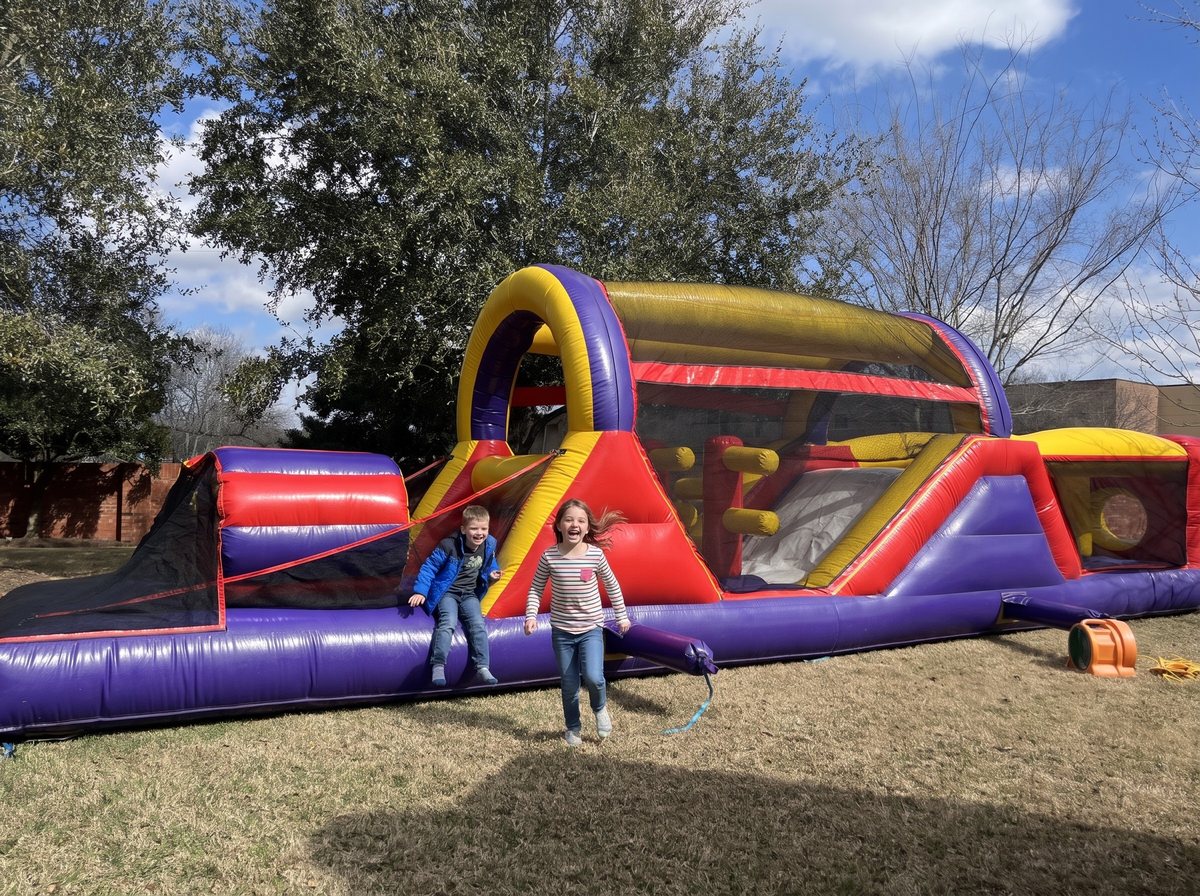
The short answer
Start 10 to 12 weeks out. Lock in the date, the space and a rain plan first. Book inflatables and tables 6 to 8 weeks ahead, because October Saturdays fill up. Plan on one inflatable for every 75 to 100 kids, one volunteer at every inflatable for every shift, and a separate power circuit for each blower. Price tickets so the rentals are covered by the first third of your crowd, and everything after that is money for your school or church.
In Houston, the two things that make or break a fall festival are heat and weather. Schedule it for late afternoon, put shade and water at every station, and decide before festival week who calls it off if a storm rolls in. The rest of this guide walks through every step, with real numbers, and ends with a printable checklist grouped by weeks out.
When should you start planning a fall festival?
Start 10 to 12 weeks before the festival. For a late-October Saturday, that means early to mid-August, right when school starts. A smaller church or classroom event can come together in 6 weeks, but anything with inflatables, food and a few hundred kids needs the longer runway.
Why so early? Three things book up or need approvals: the space (the school calendar, the church campus, the gym as a backup), the vendors (inflatables, tables, food trucks on October Saturdays), and the people (volunteers who need to be asked before their weekends fill). The money side also takes time. Sponsor letters to local businesses need about a month to turn into checks.
Pick a rain date on day one, and put it on every flyer. In Houston, hurricane season runs through November 30, and a fall cold front can bring a line of storms on any Saturday. A festival with a rain date already announced loses a weekend. One without it can lose the whole event.
Here is the timeline we suggest. Every step is also in the printable checklist at the end of this guide.
- 12 weeks outGet approval from the principal, pastor or board. Pick the date and a rain date. Reserve the field, lot and a backup indoor space. Name a chair and 4 to 6 committee leads.
- 10 weeks outSet the budget and the fundraising goal. Get quotes for inflatables, tables, food and games. Ask every vendor for insurance paperwork.
- 8 weeks outBook the inflatables, tables and chairs. Send sponsor letters. Decide the food plan and check if you need a food permit.
- 6 weeks outOpen the volunteer sign-up. Order tickets, wristbands and prizes. Draft the site map.
- 4 weeks outStart promoting: newsletter, church bulletin, parent Facebook groups, yard signs. Walk the site with facilities to check outlets and the ground.
- 2 weeks outFill every volunteer shift. Confirm the layout with your rental company. Start watching the long-range forecast.
- Festival weekConfirm every vendor. Print signs and station sheets. Get the cash boxes, first aid kit and radios ready. Make the weather call by the night before.
How much does a school or church fall festival cost?
For a festival of about 300 kids, plan on roughly $900 to $1,250 for three or four inflatables in the Houston area, plus whatever you rent in tables, chairs and games. Food, prizes, tickets and decorations come on top of that, and they depend on what you sell and what gets donated.
Across the Houston area, a bounce house combo with a slide usually rents for about $240 to $325, a basic bounce house for about $135 to $185, and an obstacle course of 35 to 40 ft for about $300 to $400. Themed and bigger units run higher. Read the fine print on time: many companies price for 4 or 5 hours. A festival runs 3 to 4 hours, plus setup and the time before the gates open, so a short clock can mean overtime fees. Ask if the price is for the full day, if delivery is included, and what the setup charge is for a parking lot.
Use the worksheet below with your own quotes. Get two or three, and compare the same things: hours, delivery, surface fees, insurance and who stays with the units. Many companies set up free on grass and add a small fee for a parking lot, concrete or indoor setup, so tell them the surface before you compare prices.
Two money tips most first-time chairs miss. First, if your school or church is tax-exempt, ask every vendor whether it accepts a Texas sales tax exemption certificate before you pay; sales tax is otherwise added to rental orders. Second, put a 10 percent cushion in the budget for the things nobody remembers until festival week: extra trash bags, zip ties, tape, batteries and ice.
| Line item | Example: about 300 kids | Notes | Your number |
|---|---|---|---|
| Inflatables | $900 to $1,250 | 2 combos with a slide, 1 small bounce house for little ones, 1 obstacle course, at typical Houston prices | $____ |
| Setup surface | Often $0 on grass | Ask about the fee for a parking lot, concrete or indoor setup | $____ |
| Tables and chairs | Your quote | About 10 tables for tickets, food, games and first aid, and 60 chairs. Borrow from the cafeteria or fellowship hall first | $____ |
| Games | Your quote | Rent carnival games or build your own from cardboard, pumpkins and bean bags | $____ |
| Sno cones or popcorn | Your quote | Sells fast in Houston heat. Count syrup, cups and bags too | $____ |
| Food and drinks | Your quote | Donated, bought to resell, or a food truck that pays you a cut | $____ |
| Tickets, wristbands, prizes | Your quote | Order 6 weeks out | $____ |
| Decorations and signs | Your quote | Hay bales, pumpkins, banners, station signs | $____ |
| Cushion | 10 percent | Trash bags, tape, ice, batteries, the forgotten stuff | $____ |
How do you price tickets and wristbands to raise money?
Work backward from your costs. Add up the rentals, divide by what one family spends, and that tells you how many families it takes to break even. Everyone after that is profit. Most schools and churches use one of two systems: tickets for everything, or a wristband for unlimited inflatables plus tickets for food and games.
The math, with real numbers
Say your rentals come to $1,500. With an unlimited inflatable wristband at $15, you break even at 100 wristbands. If 300 kids come and half of them buy a wristband, that is $2,250, so the rentals are paid for and you are $750 ahead before you sell a single hot dog.
With tickets at $1 each and 2 tickets per inflatable turn, you need 750 turns to cover $1,500. Four inflatables running for 4 hours give you plenty of room for that, which is why tickets work well for smaller crowds and wristbands work better when lines get long.
What works in practice
- Pre-sell wristbands at a small discount through the school store, the church office or an online form. You get cash early and a headcount for planning.
- Color-code wristbands by age group (for example, under 6 and 6 and up). Attendants can see at a glance who goes in which inflatable.
- Keep ticket math simple: 1 ticket for games, 2 for an inflatable or a sno cone, 3 for a plate of food. Nobody wants to do fractions at a ticket table.
- Ask sponsors to cover a unit. A local dentist, realtor or insurance agent who covers the cost of one inflatable gets a sign on it all night. Sponsors like something specific they can point at.
- Count cash in pairs. Two volunteers at every cash box, a starting float in small bills, and a card reader or payment app with a printed QR code.
Quick break-even formula
Rental total divided by price per wristband = wristbands to break even. Example: $1,500 divided by $15 = 100 wristbands. Set your price so you break even with no more than a third of your expected kids.
How many bounce houses do you need for your crowd?
Plan on one inflatable for every 75 to 100 kids you expect over a 3 to 4 hour festival. For 300 kids, that means three or four units. Mix the types so every age has something: a small bounce house for little ones, combos for the 4 to 10 crowd, and an obstacle course for older kids who would otherwise just stand around.
Where that number comes from
Say a turn lasts 3 minutes, plus about a minute to load and unload, and a combo takes a group of 6 kids at a time (check the limit posted on each unit). That is 15 turns an hour, or roughly 90 kids an hour per unit. If 300 kids each want 3 turns over 4 hours, you need about 900 turns, or 225 an hour. Divide by 90 and you get 2.5, so round up to three units, and four if you want short lines. Plug in your own crowd and hours; the same math works for any size.
Pick the right mix
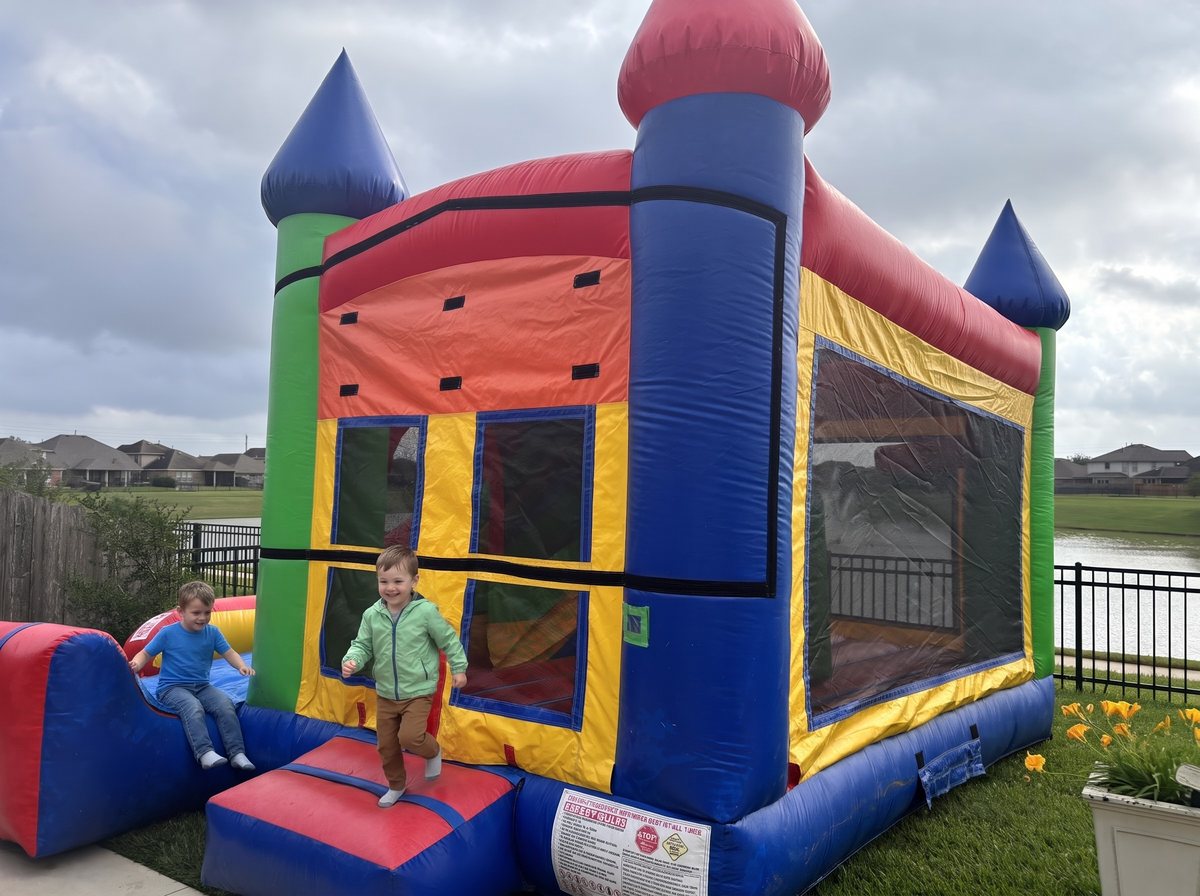
- Combo with a slide: the workhorse. A bounce area plus a slide keeps a group moving, and kids love the slide. Good for about ages 4 to 10.
- Small bounce house: a separate spot for under-5s, away from the big kids. A toddler zone keeps the little ones safe and their parents relaxed.
- Obstacle course: gives 7 to 12 year olds a race to run, and races are fun to watch, which pulls a crowd toward the inflatables. Older kids who skip the bounce house will line up for this.
One thing we see in our own bookings: churches, schools and other groups are much more likely than a backyard party to book more than one inflatable, and much more likely to need a parking-lot setup. If that is you, plan the space and power for every unit, not just the first one.
| Kids expected | Inflatables | Suggested mix |
|---|---|---|
| Up to 100 | 1 to 2 | 1 combo with a slide, plus a small bounce house if you have lots of under-5s |
| 100 to 250 | 2 to 3 | 2 combos and 1 bounce house for little ones |
| 250 to 500 | 3 to 5 | 2 or 3 combos, 1 bounce house, 1 obstacle course for older kids |
| 500 and up | 5 or more | Add combos and a second big attraction. Call the rental company to plan the layout with you |
How do you lay out a fall festival on a field or parking lot?
Draw the map before you book anything. Put the inflatables together in one zone near power, little kids at one end and big kids at the other, with the ticket table at the only way in. Food goes upwind and at least a few steps away, so nobody walks onto a bounce house with a plate of nachos.
Measure the real footprint
Each unit needs its own footprint plus room around it. A typical bounce house needs a flat spot a little bigger than 16 ft x 16 ft. A combo with a slide needs about 17 ft wide x 35 ft long. A 30 ft obstacle course is about 15 ft wide. Get the exact size of each unit from your rental company. Add space for the blower behind each unit, a line in front of it, and a walkway between units. The delivery crew also needs a clear path at least 6 ft wide from where the truck parks to every spot, so check gates, curbs and the gap between portables.
Walk the site with a measuring wheel or a 100 ft tape and mark each corner with small flags the week before. It takes 20 minutes and saves an hour of moving things on festival morning. Look up, too: no inflatable under power lines or low tree branches.
A layout that works
Most school and church festivals fit one simple pattern. One entrance with the ticket and wristband table, so every family passes it. An inflatable row along the side of the lot or field closest to outlets. Games in the middle, where parents can see them from the food tables. Food and seating at the far side, under trees or a tent. First aid and lost-and-found next to the ticket table, where everyone already knows to go.
One way in. Wristbands, tickets, a map board, first aid and lost kids all live here.
Small bounce house, toddler games, a shaded bench for parents. Keep it at the quiet end.
Combos and the obstacle course side by side near power, each with its own roped line and shoe spot.
Ring toss, bean bag toss, pumpkin decorating and the costume parade, in the middle where everyone can see.
Upwind and away from the inflatables. Tables, chairs, trash cans and a hand-washing station.
Water, sunscreen, radios, extra tickets, the cash drop and the schedule. One leader stays here.
Grass or parking lot: where should the inflatables go?
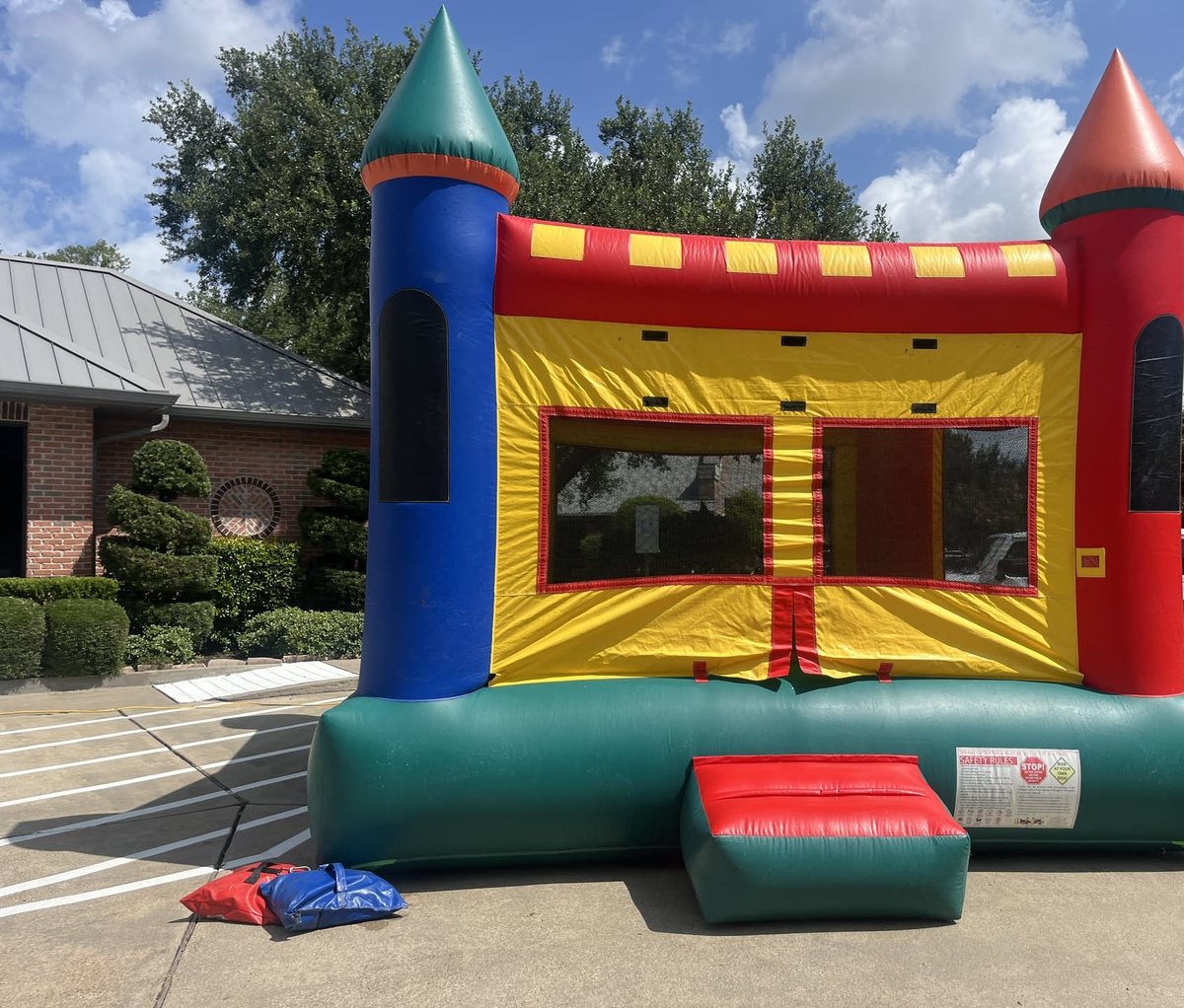
Grass is best when you have it: it is softer, cooler, and many companies set up on it for free. A parking lot works fine too; it often costs a small setup fee, and the units are held down with heavy sand and water bags instead of stakes. What does not work: sand, gravel or crushed shell, because stakes will not hold and bags can slide.
On grass, the crew drives stakes into the ground, so tell the rental company where the sprinkler lines are. A school custodian or church facilities person usually knows. Mow a day or two before, and do not water the field the night before, so the ground is firm and dry.
On a parking lot, pick the spot with no slope, no speed bumps, and no cars. Block the area off with cones the night before. Blacktop in the afternoon sun gets hot, so put the inflatables in the shadow of the building if you can, and have kids keep their shoes on until the shoe spot at the entrance.
Indoors is a real option for a rain plan. Before you count on the gym, measure the ceiling height and the doorways and send them to the rental company, so you know the units fit and can get inside.
| Grass | Parking lot or concrete | Gym or indoor | |
|---|---|---|---|
| Typical setup charge | Often free | Often a small fee | Often a small fee |
| How it is held down | Stakes | Sand and water bags | Sand and water bags |
| Heat on a sunny afternoon | Coolest | Hottest. Use building shade | Cool, if the AC is on |
| What to check first | Sprinkler lines, soft spots | Slope, cars blocked off, speed bumps | Ceiling height, doorways, outlets |
| Best for | Most festivals | Schools and churches without a field | Rain plan |
Do you need a generator, and how much power do inflatables use?
Every inflatable needs its own standard outdoor outlet, and if you have more than one unit, those outlets need to be on separate circuits. If the nearest outlets are too far away or all on one breaker, you need a generator. The blower runs the whole time; if it stops, the unit goes soft with kids inside.
Schools and churches often have only a few outdoor outlets, and they can share a breaker with the cafeteria freezer or the sanctuary lights. Two weeks out, walk the site with your custodian or facilities lead and ask three questions. Which outdoor outlets are on which breaker? Are any of them on a GFCI that trips easily? Can someone with keys be on site all day in case a breaker trips?
Ask the rental company how many amps each blower draws, and plan one blower per circuit. Food warmers, popcorn machines, coffee urns and a DJ all need power too, and they cannot share a circuit with a blower. List every plug-in item on your site map with the outlet it will use.
If you do need a generator, ask the rental company what size it recommends for each blower and who fuels it. Put generators away from where kids walk and downwind of the food area.
Cord safety
Use heavy-duty outdoor cords only. No household power strips, no plugging one cord into another, and no cords across a walkway unless they are taped down flat or covered with a cord ramp. Tell the rental company how far each spot is from its outlet, so the crew brings the right cords.
How many volunteers do you need, and where do they go?
Count on about one volunteer for every 10 to 15 kids, spread over shifts. For a 300-kid festival, that is 20 to 30 people per shift, or 40 to 60 names on the sign-up if you run two shifts. The most important rule: every inflatable has an adult watching it for every minute it is open, and that adult is not also selling tickets or texting.
Unless you hire attendants, your volunteers run the inflatables, so they need a 5-minute briefing before the gates open. Most rental crews go over the safety rules at setup, and that is the perfect time to gather your inflatable volunteers and have them listen in. Then give each station a printed half-sheet with the rules and the leader's phone number.
Keep shifts to 90 minutes to 2 hours. In Houston heat, a volunteer on a parking lot for four hours is a volunteer who will not sign up next year. Recruit early from the groups that already show up: room parents, the youth group, high school National Honor Society or service clubs that need hours, and dads who will happily run a game if you ask them directly.
| Station | Volunteers per shift | What they do |
|---|---|---|
| Each combo or bounce house | 2 | One at the line and entrance (tickets, shoes, group size), one at the exit and slide |
| Obstacle course | 2 | One starts the racers, one watches the finish and the exit |
| Ticket and wristband table | 2 to 3 | Sell, count cash in pairs, answer questions |
| Each game | 1 | Run the game, hand out prizes |
| Food | 3 to 5 | Cook, serve, take tickets, restock |
| Floaters | 2 to 3 | Give breaks, carry water, fix problems |
| Setup and cleanup | 6 to 10 | Tables, signs, trash, last walk-through |
| Lead and first aid | 1 to 2 | Weather calls, first aid, lost kids, the one person everyone can find |
How do you run lines and turns at the inflatables?
Run each inflatable in timed turns with a set group size, not as a free-for-all. Rope off a line, take tickets at the start of the line, and let one group in at a time. Kids jump with kids their own size. That one rule prevents most bounce house injuries.
A visual timer or a phone alarm at each unit keeps turns fair and keeps the volunteer from having to argue with a 9-year-old. If lines get long, shorten turns to 2 minutes rather than squeezing more kids in at once.
- 1Rope the lineUse cones and rope or caution tape to make a line that starts a few steps from the entrance, so waiting kids are not crowding the door.
- 2Take tickets at the lineCollect tickets or check wristbands at the start of the line, not at the door. The door volunteer only watches kids.
- 3Shoes, glasses and costumes offShoes go in a bin or on a tarp. Glasses, capes, masks, hats and anything sharp come off. No food, drinks or gum inside.
- 4Group by sizeSend in one group of similar-size kids. Little ones get their own unit or their own turns.
- 5Time each turnSet a timer for 3 minutes, or 2 when lines are long. Call time, everyone out, next group in.
- 6Watch the exit and the slideOne volunteer at the slide bottom keeps kids from climbing up the slide or sitting at the bottom.
How do you keep kids safe in Houston heat, wind and rain?
Heat, wind and storms are the three weather risks for a Houston fall festival, and each one needs a plan and a named person who makes the call. Decide before festival week who that is, and give them the authority to close the inflatables without a committee vote.
Heat
September and early October in Houston still feel like summer. Start the festival in the late afternoon, not at noon. Sunset is around 6:40 pm in late October and around 5:30 pm after clocks fall back in early November, so a 4 to 7 pm festival in late October gets the cooler hours with daylight to spare. The National Weather Service notes that full sun can make it feel up to 15 degrees hotter than the heat index, so shade matters. Put a water cooler at every inflatable, give volunteers water breaks, and set up a shaded cool-down spot by first aid. Inflatable vinyl in direct sun gets warm, so check it with your hand before the first turn.
Wind
Every inflatable has a wind limit set by its maker. Ask your rental company what the limit is and who decides to shut down. During the festival, if gusts pick up, the attendant calmly gets every child out first, then the unit can be unplugged. Never unplug a unit with kids inside.
Rain and lightning
Wet vinyl is slippery, so close the inflatables when it rains, even lightly. If you hear thunder, follow the National Weather Service rule, When Thunder Roars, Go Indoors: clear the inflatables and the field and move everyone inside. Have your indoor backup spot open and a volunteer ready to unlock it.
The rain plan
Decide by the evening before: go, move indoors, or move to the rain date. Post the call on every channel you used to promote the festival. Ask your rental company about its weather policy before you book, and get it in writing: who decides, by when, and what happens to your deposit.
Shut the inflatables down when
- You hear thunder or see lightning
- It starts to rain
- Gusts make the unit lean, shift or flap
- The blower stops or the unit starts to sag
- No adult is free to watch it
Get kids out first, then deal with the unit.
What insurance and permits do you need?
Ask every inflatable company for two papers before you sign: a certificate of insurance that names your school, district or church as an additional insured, and a current inspection certificate for each unit. Then check whether your own campus, district or church insurer has rules for outside vendors and inflatables. Many do.
Texas treats rented inflatables as amusement rides. Under the Texas Occupations Code, Chapter 2151, the operator of an amusement ride must have it inspected at least once a year, carry liability insurance, and give a copy of the inspection certificate and the insurance policy to the sponsor or landowner where the ride is offered to the public. At a school or church festival, that sponsor is you. For rides without a fixed location, the minimum coverage is $1,000,000 bodily injury and $500,000 property damage per occurrence, or a $1,500,000 combined single limit.
Most school districts also have their own facility-use or event forms, and some require vendor insurance with specific limits or wording, so send the certificate to the district office early. Churches should let their insurance agent know about the event; some policies cover special events and some need a rider.
Food and public land have their own rules. If you sell food prepared on site, or bring in outside vendors, ask your city or county health department whether you need a temporary food permit. If the festival is in a public park instead of on your own campus, check with the city's parks department before you book anything.
- 1Is the insurance current, and can you send a certificate naming us?Ask for the certificate of insurance with your school, district or church listed as additional insured, sent before you pay the balance.
- 2Is every unit inspected this year?Ask for the current inspection certificate for each inflatable you are renting.
- 3How is the rental priced: hours or full day?A 4-hour price can run short once you count setup and the time before gates open.
- 4What does a parking-lot or indoor setup cost?And what surfaces can they not set up on?
- 5What is the weather and cancellation policy?Get it in writing: who decides, by when, and what happens to your money.
- 6What do they need from you?Outlets, access path, a contact on site, and the time the area will be clear for setup.
What games, food and costume ideas work best at a fall festival?
The best fall festivals mix a few big draws (the inflatables, a costume parade, a cake walk) with lots of low-cost, quick games that keep lines short. Aim for one game station for every 40 to 50 kids, and make most of them 1 ticket so little kids can play everything.
Easy classic games: ring toss on pumpkins or bottles, bean bag toss through a painted board, a duck pond for toddlers, a fishing booth behind a sheet, a pumpkin bowling lane, a candy-corn guessing jar and a cake walk. Giant yard games like a jumbo Connect 4 or stacking blocks keep older kids and parents busy without a volunteer explaining rules.
For food, sell what is quick to serve and easy to price in tickets: hot dogs, nachos, popcorn, baked goods, bottled water and a sno cone stand. In Houston, a sno cone stand is a smart pick for a fall festival, because it is usually still warm out, and ice and syrup cost little per cone.
For costumes, run a short parade by age group so every kid gets a turn on stage, and give out category ribbons (scariest, funniest, best homemade, best group) instead of one winner. Remind families that costume pieces like masks, capes and props come off before the inflatables. Many churches pair the festival with a trunk or treat in the parking lot: volunteers decorate their car trunks by theme and hand out candy, which takes almost no budget and fills a corner of the lot.
Ring toss, bean bag toss, duck pond, pumpkin bowling, fishing booth, guessing jar.
Inflatables, obstacle course races, cake walk, costume parade, trunk or treat.
Hot dogs, nachos, popcorn, bake sale, water, sno cones.
Pumpkin decorating, face painting, coloring table, photo booth with hay bales.
Where can you rent inflatables, tables and games in Houston and Fort Bend?
Any good local company can work for a festival, as long as it answers the insurance and weather questions above in writing. If you are in Fort Bend County or southwest Houston, we would be glad to help. We are a locally owned Fort Bend company and have set up 1,700+ parties across Houston and Fort Bend since 2020.
What a festival gets from us: full-day rentals with no hourly clock, free delivery and setup on grass across our service area, $25 per unit on a parking lot, concrete, turf or indoors, and we pick everything up the next morning. If your site has to be locked up that night, ask about same-day pickup when you book. Every unit is cleaned and sanitized after every rental, and we are fully insured. Ask for a copy of our insurance and inspection certificates when you book: Texas law requires every operator to give them to the event sponsor. Tables and chairs can go on the same order.
For a big festival, book early: we own just one of most models, and October Saturdays go fast. Pick your date to see what is open, or call or text (346) 279-1299 and we will help you plan the mix and the layout. See every price on our rental prices and FAQ page.
Fall Festival Planning Checklist
Print it, hand it to your committee, and check things off as you go. Grouped by weeks before the festival.
12 weeks out
10 weeks out
8 weeks out
6 weeks out
4 weeks out
2 weeks out
Festival week
Festival day
After the festival
More questions organizers ask
How much does it cost to rent a bounce house for a school or church festival?
Across the Houston area, a combo with a slide usually rents for about $240 to $325, a basic bounce house for about $135 to $185, and an obstacle course of 35 to 40 ft for about $300 to $400. Many prices cover only 4 or 5 hours, and some companies add delivery or parking-lot fees. Sales tax is added unless your group is tax-exempt and the company accepts your certificate.
Do we need insurance to have a bounce house at our school or church?
The rental company needs liability insurance and a yearly inspection under Texas law, and it should give you copies. Ask for a certificate of insurance that names your school, district or church as additional insured. Your district or church insurer may also have its own rules, so check with them early.
How far ahead should we book inflatables for an October festival?
Book 6 to 8 weeks ahead if you need several units on the same October Saturday. Families book backyard parties 1 to 2 weeks out, but a festival needs several units on one date, and the best mix goes first. See how far ahead to book a bounce house for more.
Can inflatables go on a parking lot?
Yes. On a parking lot or concrete, inflatables are held down with heavy sand and water bags instead of stakes. Many companies charge a small fee for it. Pick a flat spot with no cars, curbs or speed bumps, and keep in mind that blacktop gets hot in the afternoon sun.
Can we use inflatables after dark?
Only with good lighting on the units and the lines, and an adult watching each one. In late October the sun sets around 6:40 pm, so most festivals plan to close the inflatables around dark and keep food and the costume parade going.
What happens if it rains on festival day?
Close the inflatables in any rain, because wet vinyl is slippery, and clear everyone inside at the first thunder. Pick a rain date when you pick the date, decide by the evening before, and ask your rental company about its weather policy in writing before you book.
Should we hire attendants or use volunteers?
Most schools and churches use their own volunteers: two per inflatable per shift, briefed on the rules before the gates open. If you are short on adults, ask the rental company whether it offers attendants, or rent fewer units and staff them well. An unwatched inflatable should be closed.
What are some fun games for kids at a fall festival?
Ring toss, bean bag toss, a duck pond, pumpkin bowling, a fishing booth, a cake walk, a candy-corn guessing jar, giant yard games and a costume parade by age group. Keep most games at 1 ticket so little kids can play everything.

Written by Alex, owner of Party Rentals of Houston, a locally owned Fort Bend company that has set up 1,700+ parties across Houston and Fort Bend since 2020. Questions? Call or text (346) 279-1299.
Planning a festival in Houston or Fort Bend?
Combos with a slide $275, bounce houses $185, the 30 ft Ninja Obstacle Course $299. Full day, free setup on grass, $25 on a parking lot, and we pick up the next morning. Pick your date to see what is open.
Check AvailabilityParty Rentals of Houston: partyrentalsofhouston.com, (346) 279-1299